You walk down the hallway barefoot on a Tuesday morning and one stretch of tile is warm. Not soaked, just warm, and damp at the grout line. By that afternoon the baseboard in the next room has darkened and there’s a smell you can’t place.
Somewhere in that first phone call to a restoration company, usually right after someone says “we can be there within the hour,” every homeowner asks the same thing. What’s this going to cost me?
Here’s the honest part, and it’s what most price guides skip. The water damage restoration cost in Sacramento isn’t one number, and anyone quoting a firm price before they’ve walked your house is guessing. The bill gets built from what happened, how far the water traveled, how long it sat, and what your policy covers. Once you know which pieces move that number, you can read your own situation, and you can keep it from growing while you wait on a truck.
Why nobody can price your job over the phone
Restoration isn’t a flat rate service call. Two homes can have the same failed supply line and end up thousands apart.
A real estimate comes from measuring: how far moisture spread, what kind of water it is, how many equipment days the structure needs. Those measurements become line items, so ask for a written scope of work instead of a phone number. What you can get over the phone is a response time, and in an emergency that matters more.
What drives the water damage restoration cost in Sacramento
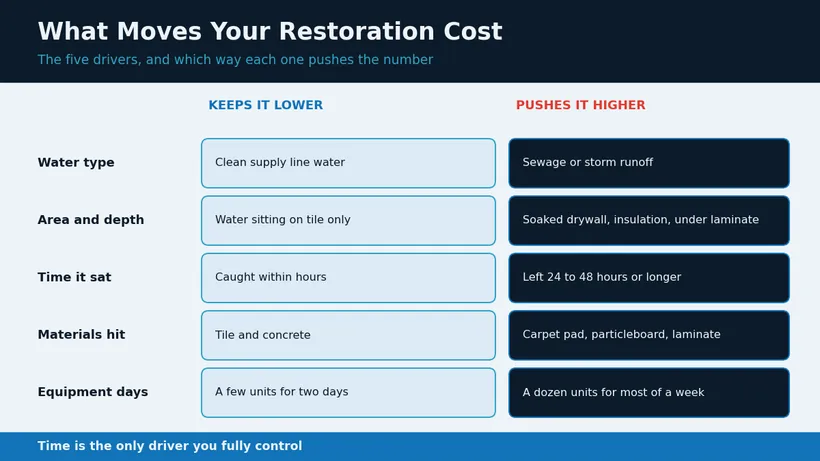
Five things move the number more than anything else.
How clean the water is
The industry sorts water into three categories. Clean water from a supply line is category one. Water that’s picked up contaminants, like a washing machine overflow, is category two. Sewage and storm runoff are category three.
Category drives price because contaminated water means removal, not drying. Carpet, pad, and often drywall come out instead of drying in place. And clean water doesn’t stay clean. Left a couple of days, it picks up whatever it touches and slides down a category.
How much got wet, and how deep
Square footage matters, but depth of saturation matters more. Water on tile is one job. Water that wicked up drywall, soaked insulation, and sat under laminate is a much bigger one, because those materials have to come out. A small leak in a bad spot can cost more than a big spill in a good one.
How long it sat
This is the driver you control. Mold can begin growing on damp materials in roughly 24 to 48 hours, and once it does, a drying job becomes a remediation job with a different scope and a different bill. Time also decides what gets saved. Hardwood caught the same day often dries flat, while the same floor left a week gets replaced.
What materials the water touched
Tile and concrete shrug water off. Carpet pad, particleboard cabinet bases, laminate, and drywall soak it up and hold it. Finish level counts too. Replacing builder grade vinyl is a different conversation than matching custom cabinetry.
How many days of equipment it takes
Air movers and dehumidifiers bill by unit per day. A small bathroom might need a few pieces for two days. A saturated great room might need a dozen for most of a week. A good crew pulls equipment when readings say the structure is dry, not on a schedule, so ask to see the daily moisture logs.

The two bills nobody warns you about
Restoration usually arrives in two parts. First comes mitigation: extracting water, pulling ruined materials, drying the structure. Then comes repair, or reconstruction, which puts the house back the way it was.
Mitigation happens in days. Repair can wait weeks, often on a separate estimate and sometimes from a separate company, and insurers commonly want those invoices split. So when you compare two companies, make sure you’re comparing the same phase. A drying quote and a rebuild quote are not the same number, and confusing them is how people feel blindsided halfway through.
How Sacramento homes change the math
Most of what you’ll read online about water damage assumes a basement. Around here that’s not the house. Sacramento, Roseville, Folsom, Rancho Cordova, Elk Grove, and Citrus Heights are built mostly slab on grade over a crawl space, which changes where water goes and what it costs to chase.
Slab leaks are the local wild card. A pipe under the concrete can run for weeks before anyone notices a warm floor. Reaching it may mean opening the slab, and drying takes longer because concrete releases moisture slowly. Crawl spaces are the other one. Water that drains under the house doesn’t announce itself, so it soaks the subfloor from below and shows up later as musty air and cupping floors.
Then there’s the calendar. November through March, valley storms bring roof and window leaks while the ground stays saturated. Water heaters and slab leaks run year round. In summer, supply lines and AC condensate lines fail in the heat, often while nobody’s home.
None of that makes your job automatically expensive. It means the local version hides longer, and hidden time is the most expensive ingredient there is.

How insurance changes what you actually pay
The real question usually isn’t the invoice total. It’s what comes out of your pocket.
Standard California homeowners policies commonly cover water damage that’s sudden and accidental. A supply line that lets go, a water heater that splits, a pipe that bursts in a cold snap. What’s commonly excluded is damage that built up over time. A slow drip, corroded pipes, deferred maintenance. Insurers call that gradual, and gradual is where claims get denied.
A few things surprise people. The pipe repair itself is often not covered even when the water damage is, since the policy covers damage rather than the failed part. Sewer backups usually need a separate endorsement, and rising water from outside generally isn’t part of a homeowners policy at all.
Your deductible comes off whatever gets approved, so on a smaller job you may pay most of it yourself. Coverage is never guaranteed and every policy differs, so call your insurer early. The longer version is in our guide on whether homeowners insurance covers water damage.
One practical note. Most policies include a duty to mitigate, meaning you’re expected to take reasonable steps to stop damage from spreading. Calling for emergency water extraction isn’t just cheaper, it’s what your policy expects of you.
Common mistakes that push the cost up
- Waiting to see if it dries on its own. The surface dries and the wall cavity doesn’t. Two weeks later there’s mold behind the baseboard.
- Using a shop vac and box fans. Household fans move air across a surface. Without a dehumidifier pulling moisture out, the water just relocates.
- Not photographing anything. Take pictures and video before you move or throw out a single thing, because adjusters often want to see what was ruined.
- Skipping the crawl space and the ceiling below. Water goes down. If the leak was upstairs, somebody needs to look underneath it.
What this looked like on one Citrus Heights street
Picture two single story houses on the same block, both slab on grade, both with a bathroom supply line that failed the same rainy February week.
The first owner heard something at nine at night, shut the angle stop, and called before bed. Crews extracted, pulled the vanity toe kick, and dried the bathroom and a strip of hallway. Three days later the readings matched the rest of the house.
The second house sat empty that week. The leak spread under the laminate into a bedroom, wicked up two walls, and dripped into the crawl space. By the time anyone opened the door it smelled musty and the flooring had cupped. One was a drying job. The other became demolition, remediation, new flooring, and paint. The only real difference was time.
What to do next
- Stop the water at the fixture valve, or at the main on the street side of the house.
- Kill power to any wet area at the breaker before walking through standing water.
- Call for emergency help. Starting extraction today is the biggest thing you can do to hold the number down.
- Open a claim, ask about your deductible, and get a written scope that says whether it covers mitigation, repair, or both.
Key takeaways
- There’s no single water damage restoration cost in Sacramento. Your number comes from water category, area and depth, elapsed time, materials, and equipment days.
- Expect two phases, mitigation and repair, often on two separate estimates.
- Local homes are mostly slab on grade with crawl spaces, so slab leaks and under house water hide longer.
- Insurance often covers sudden and accidental damage but commonly excludes gradual leaks, sewer backups, and outside flooding.
- Time is the one driver you control. Calling within hours instead of days keeps a drying job from becoming a rebuild.
Frequently asked questions
Is restoration cheaper here than elsewhere in California?
Labor and material rates in the Sacramento metro generally run below coastal California markets, so comparable work here often prices lower than the Bay Area. Your job is still priced on your damage.
Does the restoration company bill my insurance directly?
Many work directly with insurers and bill the carrier, leaving you the deductible and anything not covered. Confirm that in writing before work starts, and remember you always choose who works on your home.
Can I just dry it myself and save the money?
For a small clean water spill on a hard surface caught immediately, sometimes yes. Once water reaches carpet pad, wall cavities, subfloor, or a crawl space, home equipment usually can’t beat the mold window, and the EPA’s guidance on mold cleanup is a good reality check. Not sure how bad yours is? A moisture meter inspection will tell you, and our Sacramento water damage restoration guide covers that first visit.
Getting help right now
If there’s water on your floor while you’re reading this, the cost question can wait twenty minutes. Stopping the spread can’t.
WaterDamageOnCall is a water damage information and lead request service. We’re not a licensed restoration contractor, and this article is general information rather than professional restoration, insurance, or health advice. Costs and coverage vary by home, insurer, and situation, so a licensed local pro should assess yours. Information you submit may be shared with restoration professionals in your area.
Ready to have someone look at it? Call for fast 24/7 emergency help, or request help through our form and we’ll connect you with a licensed local pro who can tell you what you’re actually dealing with.