You flush, and instead of dropping, the water climbs. For a second or two you just stand there watching the bowl fill, silently bargaining with it. Then it comes over the rim and spreads across the tile toward the hallway.
That moment is awful, and it’s also the one that matters most. What you do next decides whether this ends as an hour with towels or a week with fans and torn out baseboards.
So here’s the order of operations. Stop the water at the valve behind the toilet, keep people and pets off the wet floor, and treat what spilled as contaminated until you’re sure it isn’t. Then dry everything fast. The rest walks through toilet overflow cleanup the way a restoration crew thinks about it.
Stop the water first, then step back
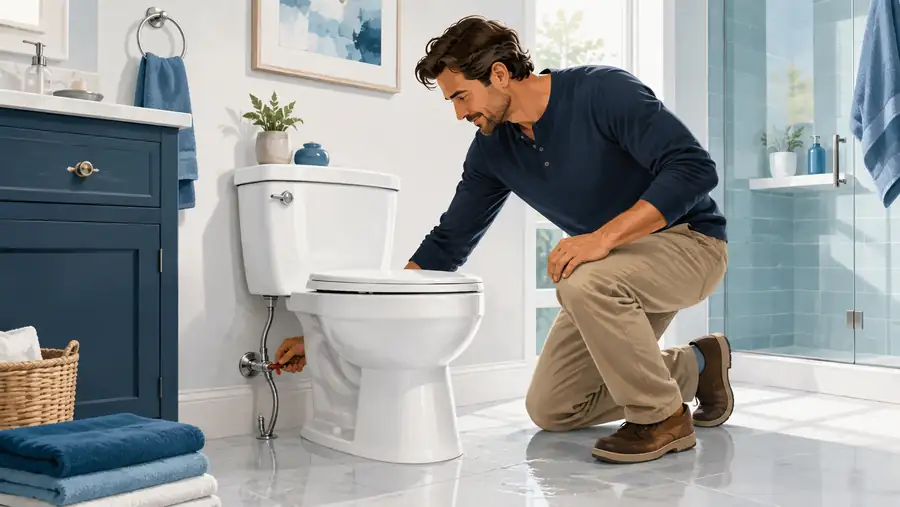
Reach behind the toilet, low and usually to the left, and find the small oval knob on the water line. That’s the shutoff valve. Turn it clockwise until it stops.
If the valve is stuck or corroded, lift the tank lid and press the rubber flapper down into its seat with your hand, then lift the float so the tank stops refilling.
Do not flush again to see whether it cleared. A second flush sends another gallon and a half into a bowl that already has nowhere to send it. That one reflex is how a puddle becomes a soaked hallway. Once the water stops, get shoes off the wet floor, keep kids and pets out, and open a window.
Is it clean water, gray water, or sewage?
Restoration pros sort water into three categories, and the category drives nearly every decision that follows. Category 1 is clean water off the supply line. If the bowl was clear and the fill valve stuck open, what’s on your floor is essentially tap water. Best case, and it still has to be dried fast.
Category 2, or gray water, carries some contamination but no human waste. Picture a bowl that had been used and flushed and looked mostly clear when it came over.
Category 3 is the one to respect. This is water carrying human waste, or water that came back up out of the sewer line or a septic system. It can carry bacteria and viruses that make people genuinely sick. Our guide to water damage categories breaks all three down.
The practical rule: if there’s visible waste, if the water came up rather than over, or if it sat more than about a day, treat it as category 3 and call a pro. Clean water degrades as it sits, so the clock matters as much as the source.
What made your toilet overflow
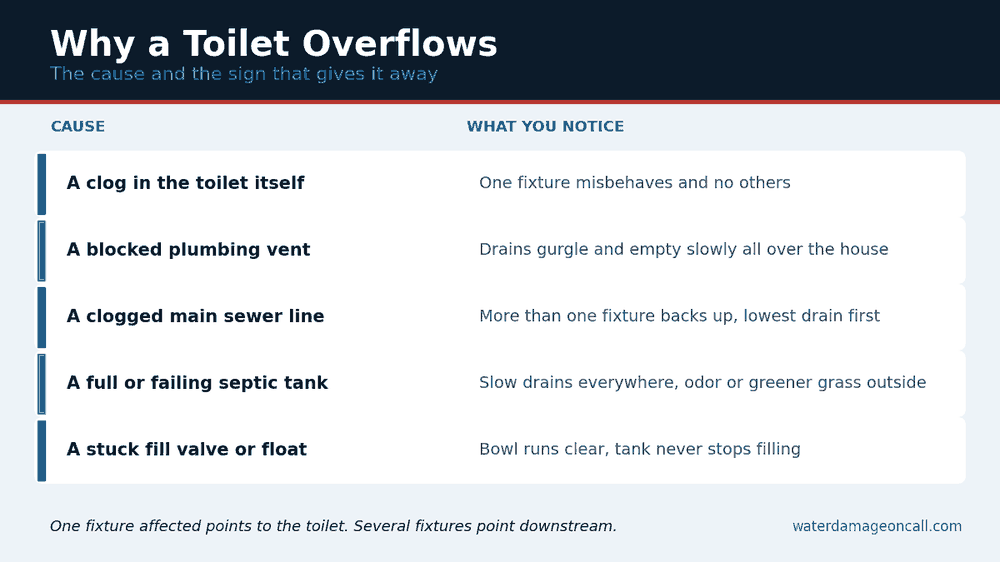
A clog in the toilet itself. The most common cause by a wide margin. The sign: one fixture misbehaves and no others.
A blocked plumbing vent. Drain lines need air to move water. When the roof vent gets plugged by leaves or a nest, drains all over the house gurgle and empty slowly.
A clogged main sewer line. Tree roots and aging pipe are usually behind this one. More than one fixture backs up, and the lowest drain acts up first. If flushing makes the shower drain bubble, the blockage sits downstream of both.
A full or failing septic tank. Drains run slow everywhere, sometimes with an odor near the tank or a patch of grass that’s suddenly greener.
A stuck fill valve or float. The bowl runs clear and the tank simply never stops filling. Annoying, but the water is clean and the fix is usually a cheap part.
If the cause sits past the toilet, a plumber has to clear the line before drying is worth doing. Otherwise the next flush puts you right back where you started.
Toilet overflow cleanup, step by step
This part is for a small clean or gray water spill. If it’s sewage, skip to the next section.
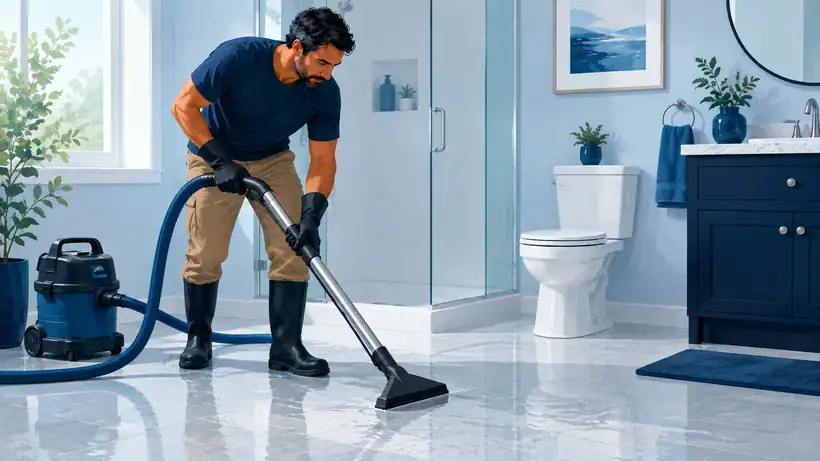
Put on gloves, closed shoes you can wash, and eye protection. A mask is smart if there’s any smell. Bag your clothes separately afterward and wash them hot.
Push the water back toward the bathroom with old towels, or pull it up with a wet vacuum. Wring towels into the tub, never onto more floor.
Pull up anything soft that got soaked. Bath mats and small rugs can go through a hot wash. Wet cardboard and anything that sat in category 2 or 3 water goes in the trash, because porous materials hold contamination in a way scrubbing does not fix.
Clean before you disinfect, since disinfectants work poorly on a dirty surface. The CDC’s household bleach guidance works out to roughly a third of a cup of regular unscented bleach per gallon of room temperature water, left wet for the contact time on the label. Never mix bleach with another cleaner. Bleach and ammonia together make a gas that can land you in an emergency room.
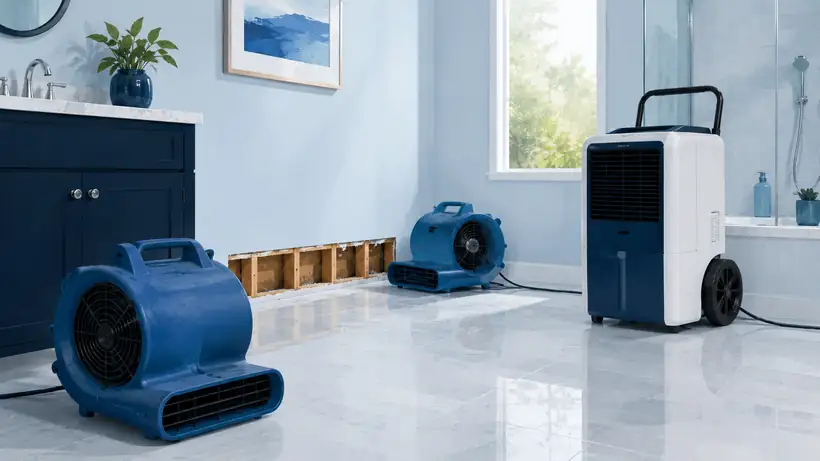
Then dry, harder and longer than feels reasonable. Open windows, run the bathroom fan, and aim box fans across the floor. Everything needs to be dry inside 24 to 48 hours, the rough window in which mold starts on damp material.
Where the water goes that you cannot see
The visible puddle is usually the smallest part of the problem. Water finds every seam: under vinyl and tile at the edges, around the toilet flange, behind the baseboard, into the gap where flooring meets wall. Once it’s under a floor covering it can sit for weeks with no trace on the surface.
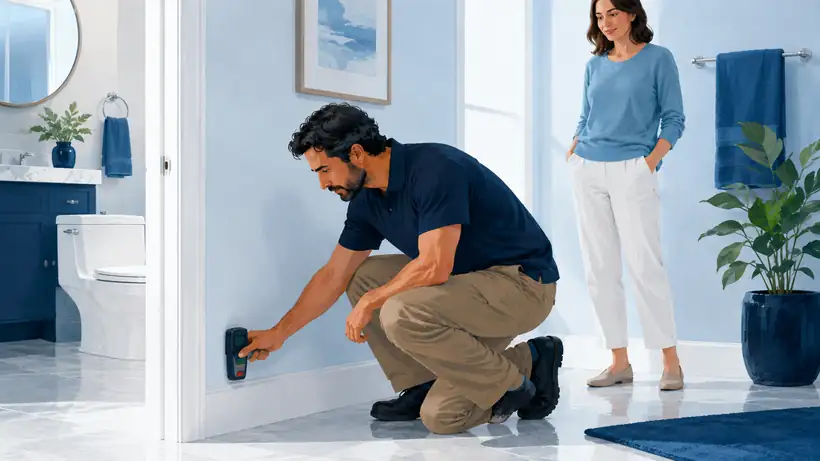
Upstairs bathrooms are worse, because gravity takes over. Water drops between the joists and shows up as a stain, a sag, or a drip in the ceiling below, often a room away. A brown ring on a downstairs ceiling means water is already inside the structure, not sitting on the floor waiting to be wiped up. A moisture meter settles that question in minutes.
When to stop and call a professional
Some overflows are a towel job. These are not. Call for help when there’s sewage or visible waste on the floor, when more than one fixture is backing up, when water reached carpet, drywall, or the room below, or when it sat longer than about a day. Anyone who’s pregnant, elderly, very young, or immune compromised should stay out of a contaminated area completely.
A crew brings what you can’t rent your way around: real extraction, antimicrobial treatment, moisture meters, containment so contamination doesn’t ride through the house, and drying equipment sized for the room. Look for a company that’s licensed, insured, IICRC certified, and answers the phone at 2am. Our sewage cleanup page covers that process.
On the money question, homeowners policies often cover sudden and accidental water damage from a fixture like a toilet, while damage from a sewer or drain backup commonly requires separate coverage you have to add on. It varies by policy, insurer, and cause, so call your insurer early and photograph everything before you move it.
Common mistakes that make it worse
Flushing again to test it. Still the number one mistake, still the most expensive.
Pouring chemical drain opener into the bowl. Those products are built for sinks, they sit uselessly in standing water, and they turn the spill into a chemical hazard.
Mopping sewage. A mop spreads contamination and then you own a contaminated mop. Extract and discard instead.
Calling it dry because the surface feels dry. Surfaces dry first and structure dries last, and that gap is where mold lives.
What this looks like in a real house
Rachel’s upstairs toilet backed up on a Saturday morning while she was home. She shut the valve inside a minute, emptied the linen closet onto the floor, ran the exhaust fan plus two box fans, and washed the bath mat hot. By Monday it was dry. Total cost: one bath mat.
Her neighbor’s did the same thing on a Friday afternoon in a bathroom over the garage, and nobody noticed until Sunday night. By then the water had gone under the vinyl, through the subfloor, and into the garage ceiling. Drywall out, flooring out, subfloor dried and partly replaced, plus a claim and ten days of equipment running.
Same gallon and a half of water. The only real difference was how many hours it got to sit.
What to do next
If the water is stopped and the floor is dry to the touch, keep the fans going another full day, then check the baseboard and the room below in the morning.
If the water was contaminated, or you can’t tell how far it got, don’t guess. Toilet overflow cleanup done properly on day one costs a fraction of what it costs in week two.
Key takeaways
- Shut the valve behind the toilet first, and never flush again to test it.
- Treat the water as contaminated if there’s waste, if it came up the drain, or if it sat more than a day.
- Find out whether the clog is in the toilet or downstream, because a main line blockage repeats.
- Clean first, disinfect second, dry inside 24 to 48 hours.
- Check the wall base, under the flooring, and the ceiling below before you call it finished.
Frequently asked questions
Is toilet overflow water always contaminated?
No. If the bowl was clear and a stuck fill valve caused it, what spilled is basically clean supply water. If the bowl had been used, or the water came back up the drain, treat it as contaminated.
Can I handle toilet overflow cleanup myself?
Often yes, when it’s a small amount of clean or gray water on a hard floor and you catch it immediately. Sewage, soaked carpet, wet drywall, or water that reached the room below is a job for a pro.
How long does a bathroom take to dry after an overflow?
A shallow spill on tile can be dry in a day with good airflow. If water got under the flooring or into the wall base, plan on roughly three to five days with proper equipment, and let moisture readings decide when it’s done, not the calendar.
Does homeowners insurance cover a toilet overflow?
Policies often cover sudden and accidental overflow from a fixture, while sewer or drain backup commonly needs separate coverage. It depends on your policy and the cause, so call your insurer early and document everything before you start cleaning.
WaterDamageOnCall is a water damage information and lead request service. We are not a licensed restoration contractor. This article is general information, not professional restoration, insurance, or health advice, and a licensed local pro should assess your situation.
Standing in a wet bathroom right now? Call for fast 24/7 emergency help, or request help through our form and we’ll connect you with a local pro.