
You spot it while you’re lying on the couch, or standing on a chair to change a bulb. A faint brownish ring on the drywall that you’re fairly sure wasn’t there a month ago.
Then the argument with yourself starts. Maybe it’s old. Maybe it’s always been there and you never looked up.
Here’s what’s worth knowing before you talk yourself out of it. That mark isn’t the problem. It’s the receipt for a problem that happened above your ceiling, and the only question that matters is whether that problem is still going on right now.
First, is the ceiling safe to stand under?
Look at the shape of the ceiling, not just the color. If any part of it is sagging, bulging, or drooping, move everyone out from under it. Drywall soaks up a startling amount of water, gets heavy, and tends to let go all at once rather than warning you first.
If the stain touches a light fixture, a ceiling fan, or a smoke detector, treat it as an electrical problem too. Water and wiring share that cavity. Shut that circuit off at the breaker and leave the fixture alone.
Water stain on ceiling: is the leak still active?
This is the fork in the road. An old dried mark is a paint job. A live one is a countdown.
Press gently on the edge with a fingertip. Firm board with a crisp, dry edge usually means the water came and went a while ago. Soft, cool, or spongy means water is in there right now.
Then read the pattern. One even patch of light brown is usually a single old event that dried. Concentric rings, like the marks inside a coffee cup, mean the same spot got soaked, dried, and soaked again, which points to something still happening. A dark center with lighter edges usually means water is still arriving.
Then run the cheapest test there is: trace the outer edge in pencil and write the date beside it. Check it in 48 hours and again after the next real rain. If the stain has crossed your line, you have your answer.
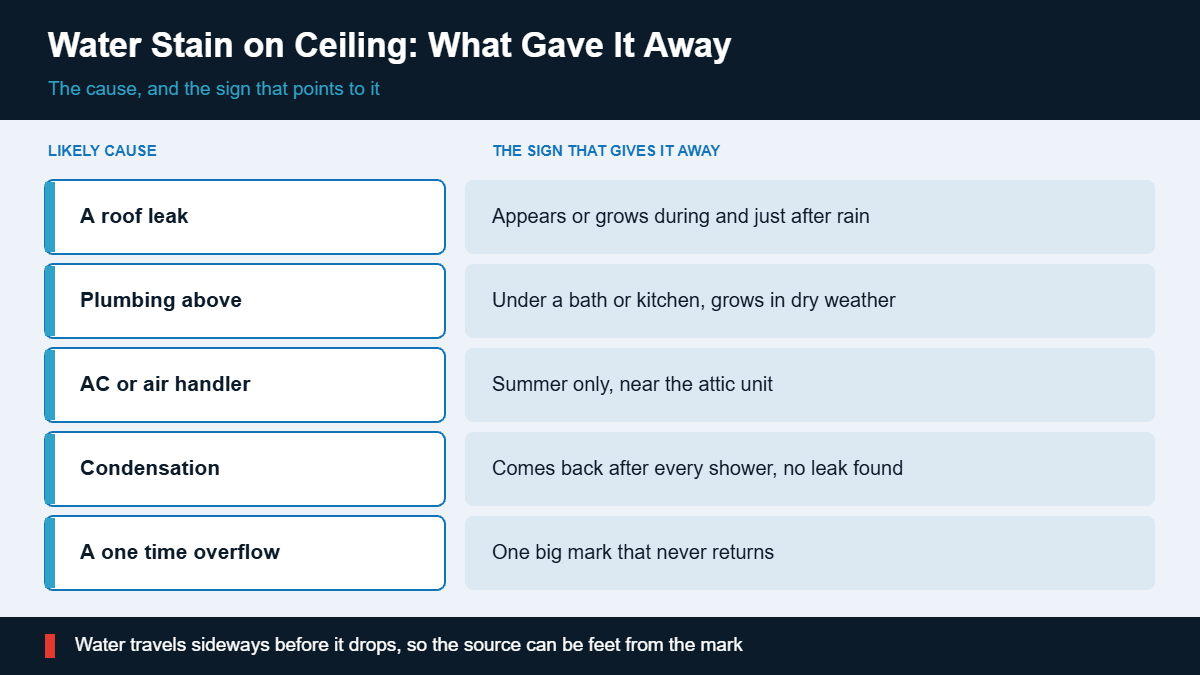
What causes a water stain on ceiling drywall
Most homeowners assume roof. Roofs are only part of the story, and guessing wrong costs weeks.
A roof leak
The giveaway is weather. A roof leak appears or grows during and just after rain, then goes quiet. It often sits near an exterior wall, a chimney, a vent stack, or a roof valley. From the attic, look above the mark for damp insulation or dark trails down a rafter.
A plumbing leak from the floor above
A stain under an upstairs bathroom, kitchen, or laundry room that shows up in dry weather is almost always plumbing. A supply line is pressurized all the time, so it drips constantly and the stain grows steadily. A drain line only leaks when someone runs the fixture, so that stain grows in bursts.
An air conditioner or air handler
An attic air handler makes condensation all summer and drains it through a narrow line that loves to clog with algae. When it backs up, the overflow pan fills or simply spills. The tell is the season: a mark that shows up in July, near the unit, with no rain in the forecast.
Condensation and bad venting
Sometimes there’s no leak at all. A bathroom exhaust fan that dumps into the attic instead of outside pumps warm wet air onto cold framing every single shower, and that moisture condenses and drips back down. Thin insulation does the same thing in cold weather.
A one time overflow
An overflowed tub, a toilet that ran over, a washing machine that emptied onto the floor above. Big stain, dramatic arrival, then nothing ever again, and somebody in the house remembers it.
One thing complicates all five. Water rarely falls straight down. It runs along a joist, follows a wire, rides a duct, and drops at the first low point it finds. So the stain marks where water landed, not where it got in, and the source can easily be several feet away.

What to do in the first 24 hours
Water damage is one of the few household problems where the clock genuinely matters. Materials dried quickly get saved. Materials left wet get replaced.
- Photograph the stain and the room before you move or clean anything.
- Contain it with a bucket, a tarp, and towels.
- Stop the source if you can reach it. Shut the supply valve to the fixture above, or the main valve if you’re not sure which.
- Get eyes above the ceiling through the attic hatch or a closet access panel.
- Move air. Open the room up, run a fan, run a dehumidifier if you have one.
- Call someone if the mark is spreading, spongy, or bigger than a dinner plate.
And don’t paint over it yet.

What you can’t see above the stain
The visible mark is maybe a tenth of the story. Above it sits insulation that holds water like a sponge, framing that stays damp long after the surface feels fine, and drywall paper, which happens to be excellent food for mold.
In consistently wet material, mold can begin establishing itself within roughly 24 to 48 hours. That’s why a small mark quietly fed for three months is often a bigger job than a large one from last night. Our guide on how long mold takes to grow after water damage walks through the timeline, and the EPA’s mold cleanup guidance covers what’s reasonable to handle yourself.
Why painting over it never works
The minerals that make the mark brown bleed straight back through ordinary latex paint, often within days. You need a stain blocking primer, and even that only holds if the board underneath is genuinely dry.
The bigger problem is that painting erases your only monitor. That stain was quietly reporting on the leak for you. Cover it and you lose any way to tell whether something changed, which is how a small plumbing repair becomes a replaced ceiling two years later.
Fix the source, dry the cavity, confirm it with a meter, then prime and paint. In that order.

When to call a professional
- The ceiling is sagging, bulging, or soft to the touch.
- The stain is growing, or came back after you thought it was handled.
- There’s a musty or earthy smell in the room.
- The stained area is near light fixtures, a fan, or an electrical box.
- The water may have come from a drain line or a toilet, which puts it in a dirtier category.
- You’ve looked and you still can’t find the source.
A restoration crew brings moisture meters and thermal cameras that map the wet area through the drywall, so the ceiling gets opened where the water actually is. You can see how that works on our water damage services page.
Will insurance cover it?
Homeowners policies often cover sudden and accidental water damage, such as a supply line that fails without warning or a storm that tears shingles loose.
The complication with ceiling stains is that they’re slow by nature. Damage from long term seepage, or a leak an adjuster decides you should have caught, is commonly excluded as a maintenance issue. Coverage varies by policy and by state, so your own insurer is the only real authority here.
Practically: photograph it early, report it promptly, keep every receipt. Our guide on whether homeowners insurance covers water damage goes deeper, and the water damaged ceiling repair guide covers what happens once the ceiling is opened.
Common mistakes to avoid
- Painting first and investigating never. The most expensive habit in this whole category.
- Waiting for the next storm to confirm it while the cavity stays wet the whole time.
- Hanging new drywall before a meter says the framing is dry.
What this looks like in real life
Dana noticed a pale ring in her dining room ceiling on a Sunday. She penciled the edge, wrote the date, and went about her week. It never rained, and by Wednesday the stain had crept past her line by about an inch.
Dry weather plus steady growth pointed away from the roof, and the upstairs bathroom sat right above. A plumber found a weeping supply connection under the vanity. Small repair, two days of drying, one patched section of ceiling.
Compare that with a family two streets over who painted over a similar mark twice across two years. The third time it came back, the ceiling was sagging. Their bathroom fan had been venting into the attic the whole time, and that job took wet insulation, mold remediation, and a full ceiling replacement.
Key takeaways
- A stained ceiling is evidence, not the problem. Find what’s above it.
- Press the edge. Firm and dry means old. Soft or spongy means live.
- Rain points to the roof. Dry weather under a bathroom points to plumbing. Summer near an attic unit points to condensate.
- Wet material can start growing mold in about 24 to 48 hours, so speed beats perfection.
Frequently asked questions
How do I know if a ceiling stain is serious?
Movement and texture matter more than size. A small mark that’s growing, soft, or paired with a musty smell is more urgent than a large one that’s bone dry and hasn’t changed in years.
Can a water stain on ceiling drywall dry on its own?
The surface can, which is what makes it deceptive. Insulation and framing above dry far more slowly, and in a closed cavity with no airflow they can stay damp for weeks after the surface feels normal.
Does a stain always mean there’s a leak right now?
No. Plenty of them are old scars from something already repaired, sometimes by a previous owner. The pencil line and the finger test will tell you which kind you have within a couple of days.
If your mark is dry, unchanged, and you know the story behind it, you’re looking at primer and a roller. If it’s soft, spreading, or smells musty, get it looked at today rather than after the next storm.
WaterDamageOnCall is a water damage information and lead request service. We are not a licensed restoration contractor, and this article is general information rather than professional restoration, insurance, or health advice. Every home is different, so a licensed local professional should assess your specific situation. Information you submit may be shared with local pros who can help.
Need someone to look at it now? Call for fast 24/7 emergency help, or request help through our quick form and we’ll connect you with a local water damage pro who can find the source and dry it properly.