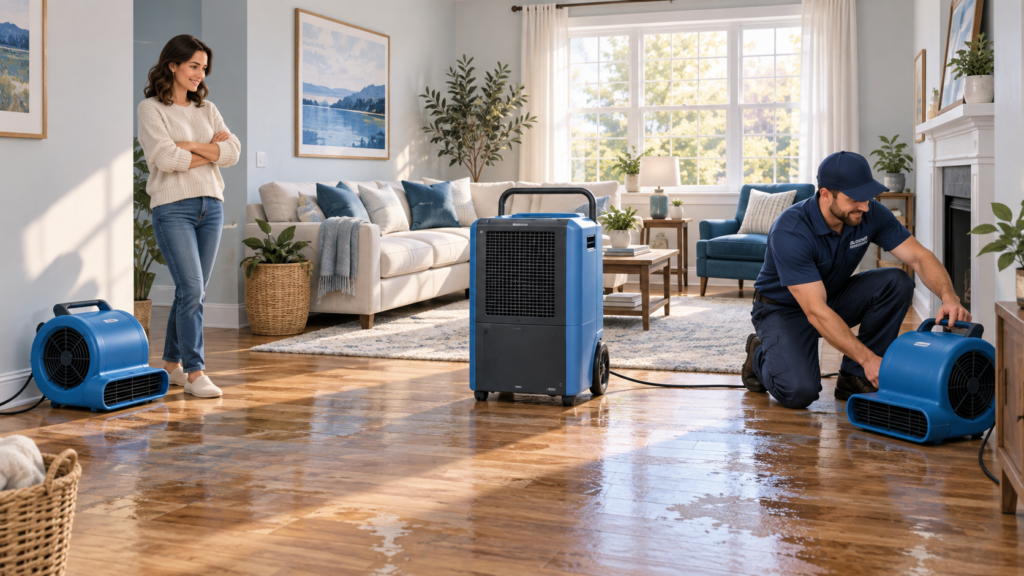
The supply line under your bathroom sink lets go at nine in the morning. You get home at six, shut the valve, push a pile of towels around, and by the next afternoon the tile looks fine. Case closed, you figure.
Two weeks later the baseboard is curling away from the wall and there’s a smell in the hallway you can’t quite place.
That gap between “looks dry” and “is dry” is where the expensive damage hides. Water wicks up drywall, soaks into the subfloor, and runs under vinyl plank into the wall cavity where nothing you own can reach it. Real drying means pulling it back out of the materials themselves, which takes more than a box fan and an open window.
The clock you’re racing
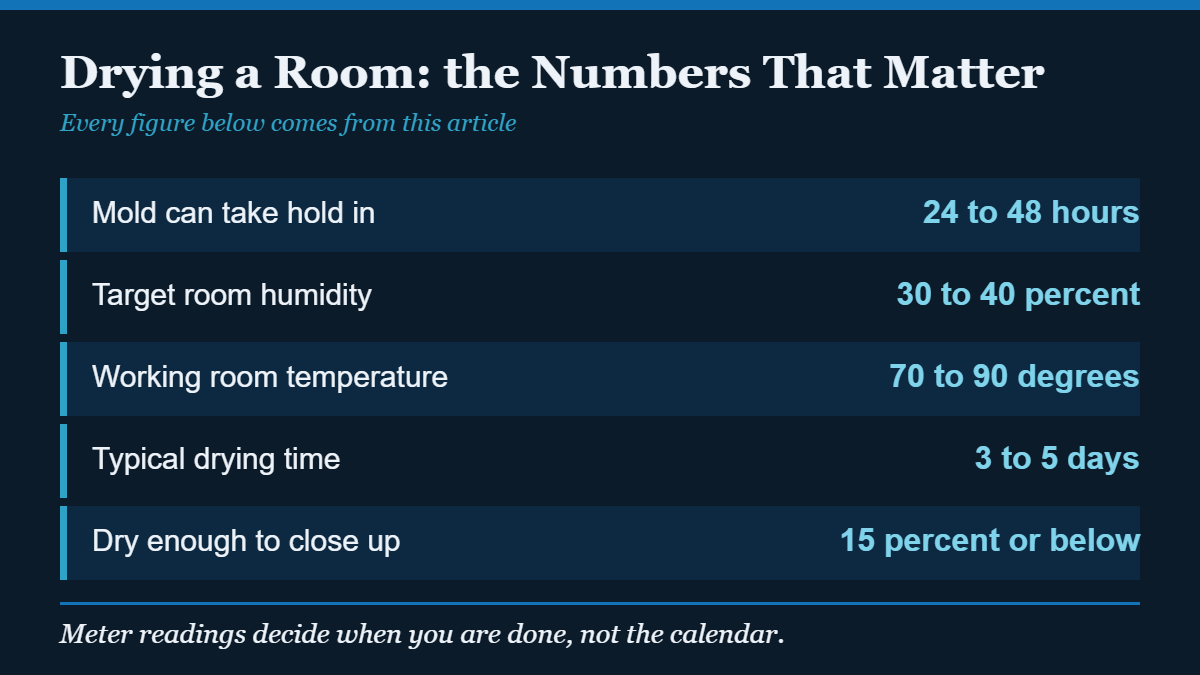
Mold spores are already in your house, doing nothing at all. Hand them a wet sheet of drywall in a warm room and they stop. Under the right conditions growth can take hold in roughly 24 to 48 hours, which is why restoration crews show up at two in the morning instead of scheduling you for Thursday. We laid out the full timeline in how long mold takes to grow after water damage.
Water is also still moving while you read this. It spreads sideways along the subfloor and climbs drywall, so a bathroom leak can turn up as a wet closet carpet two rooms away.
Stop the water and pull it out first
No amount of fan time helps while the source is still running. Close the fixture valve, and if you can’t find it, shut the main, usually near the front hose bib, in the garage, or at the street side meter box.
Then think about electricity before you step anywhere. If water is standing near outlets, a furnace, or the panel itself, stay out and kill the breaker from a dry spot, or call an electrician.
Then get the bulk water up with a wet vac, a rented extractor, or a mop and towels. Every gallon you remove is a gallon you don’t have to turn into vapor and pull back out of the air. That’s why crews run water extraction before they set a single piece of drying equipment.
How to dry out water damage: the three forces that do the work
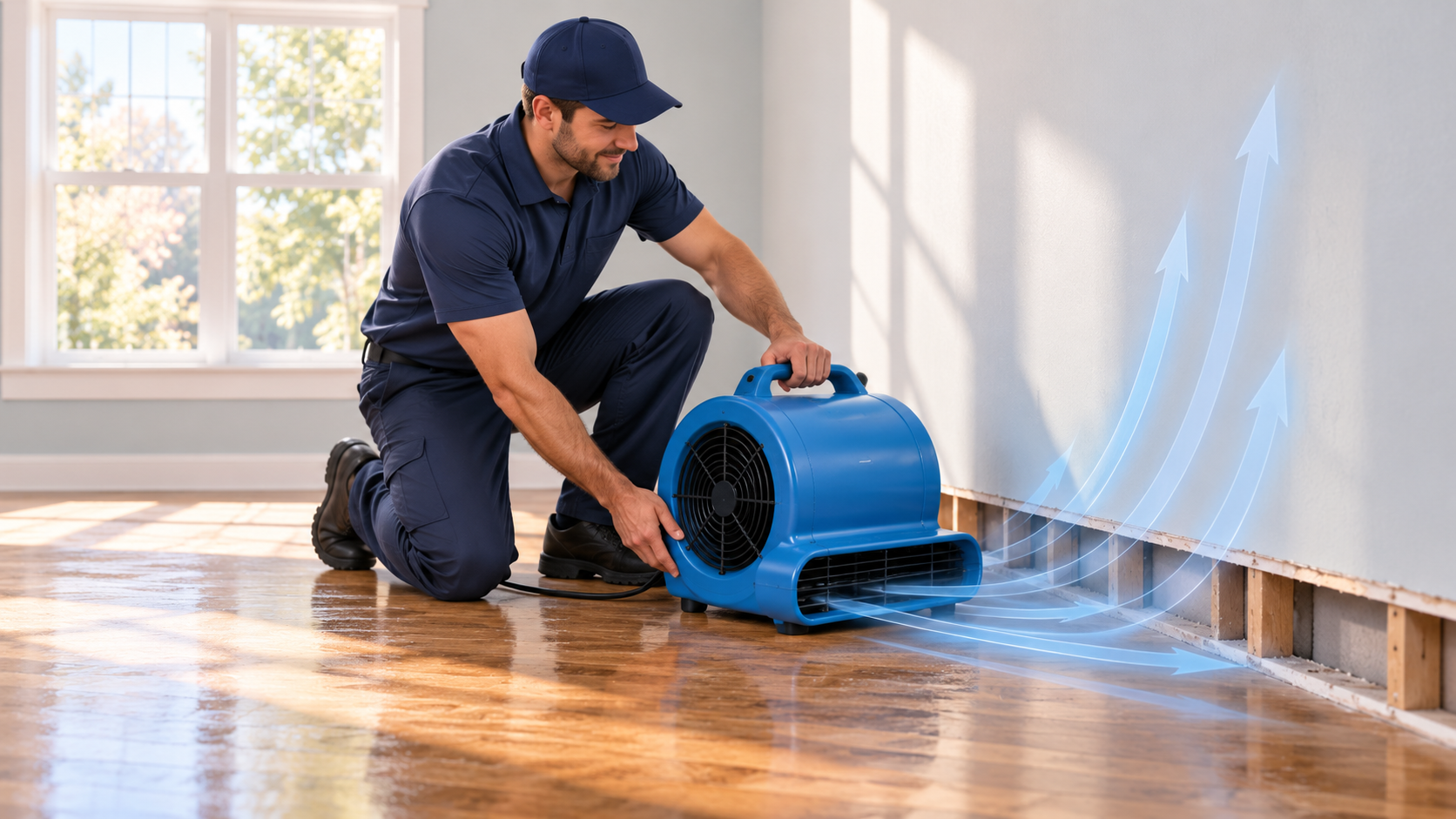
Every drying plan rests on three things. Air movement, dehumidification, and warmth. Skip one and the other two crawl.
Move air across the wet surface
A thin skin of saturated air sits on every damp surface and acts like a lid. Until you strip it off, evaporation nearly stalls. That’s the real job of an air mover, so aim the airflow along the wet surface at a shallow angle, not straight into it.
Pull the moisture out of the air
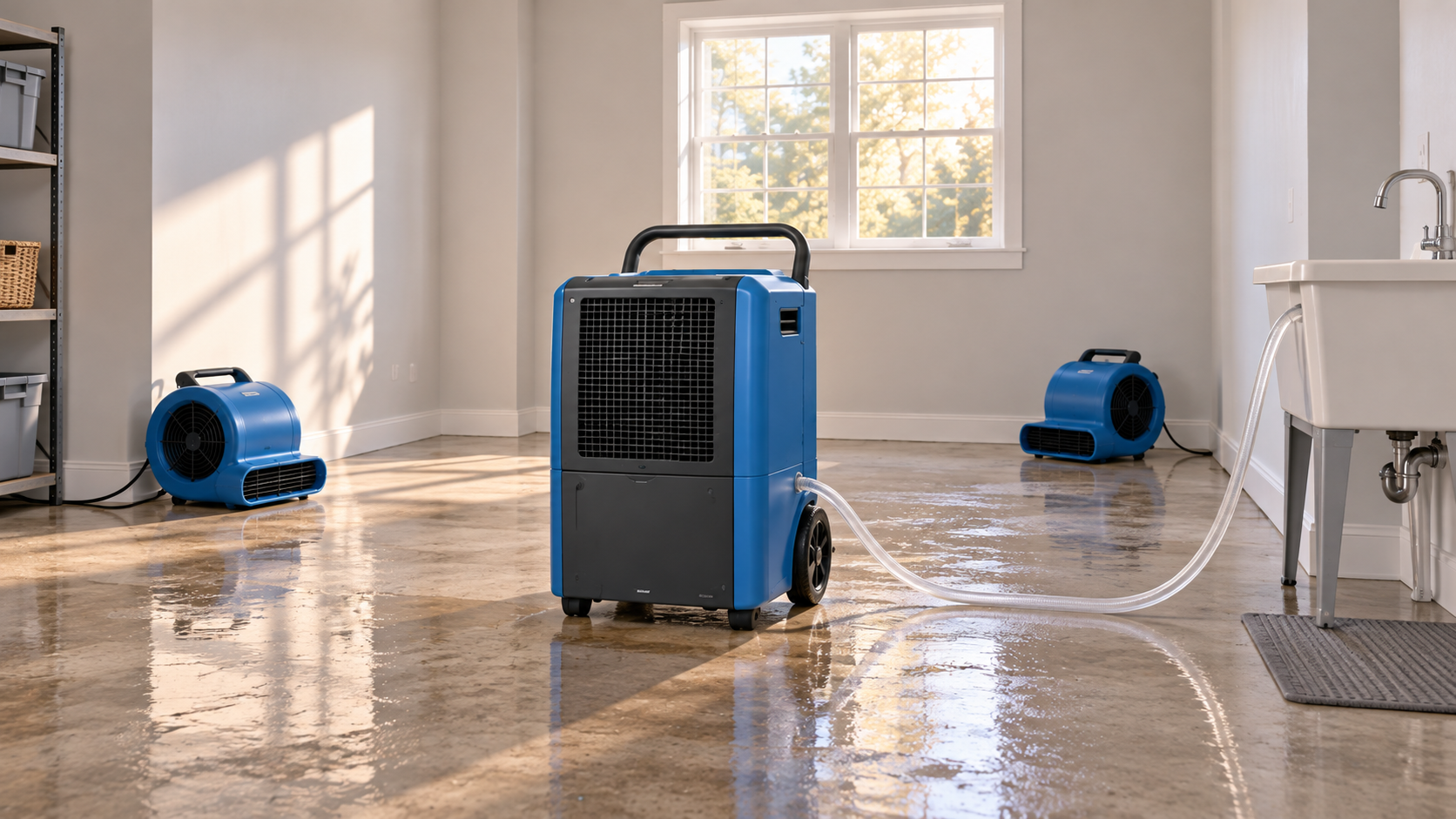
Here’s the part most people miss. Fans by themselves don’t dry anything. They move water out of your floor and into your air, and that air gives it back somewhere you can’t see. A dehumidifier takes it out of circulation. Crews generally hold the room around 30 to 40 percent relative humidity, and a drain hose beats a bucket, because a full tank at midnight costs you six hours.
Keep the room warm
Warm air holds more moisture than cold, so a chilly room dries slowly no matter how many fans you point at it. Pros commonly work in the range of 70 to 90 degrees.
Placement matters too. Set air movers on the floor along the walls, all pointed the same direction so air circles the room instead of colliding in the middle. Put the dehumidifier near the center with clearance around it, then close the doors and windows. You want a small sealed box, not the whole house.
What has to come out before anything can dry
Some materials never dry in place, and leaving them there keeps everything around them wet. Carpet padding is the classic offender. It’s a sponge by design, it holds water against the subfloor for weeks, and it’s cheap enough that saving it rarely pays.
Baseboard usually has to come off too. Not because the trim is ruined, but because a wall cavity can’t breathe behind a sealed strip of wood. Crews often drill small weep holes low on the drywall for the same reason.
Soaked fiberglass insulation is another. It loses its R value and sits in the wall staying damp. Whether the drywall survives depends on how long it was wet and how high the water climbed, which we covered in wet drywall repair or replace.
Should you open the windows?
It depends on what the air outside is doing, and this trips up a lot of well meaning homeowners. On a cool, dry day, open windows help. On a muggy 85 degree afternoon, you’re pumping moisture into the room you’re trying to dry.
Check the humidity on your phone first. If it’s more humid outside than inside, close everything up and let the dehumidifier work.
How long it takes, and how to know you’re done
With equipment running around the clock, a typical residential job lands somewhere around three to five days. Saturated framing, hardwood, thick insulation, or anything soaked from above can take a week or longer. Those are general ranges, not promises, and how fast you started moves the number more than anything else.
Your hand is not a moisture meter, and neither is your nose. Surfaces feel dry days before the cavity behind them is, which is the biggest reason homeowners think a room dried fine and find a problem months later.
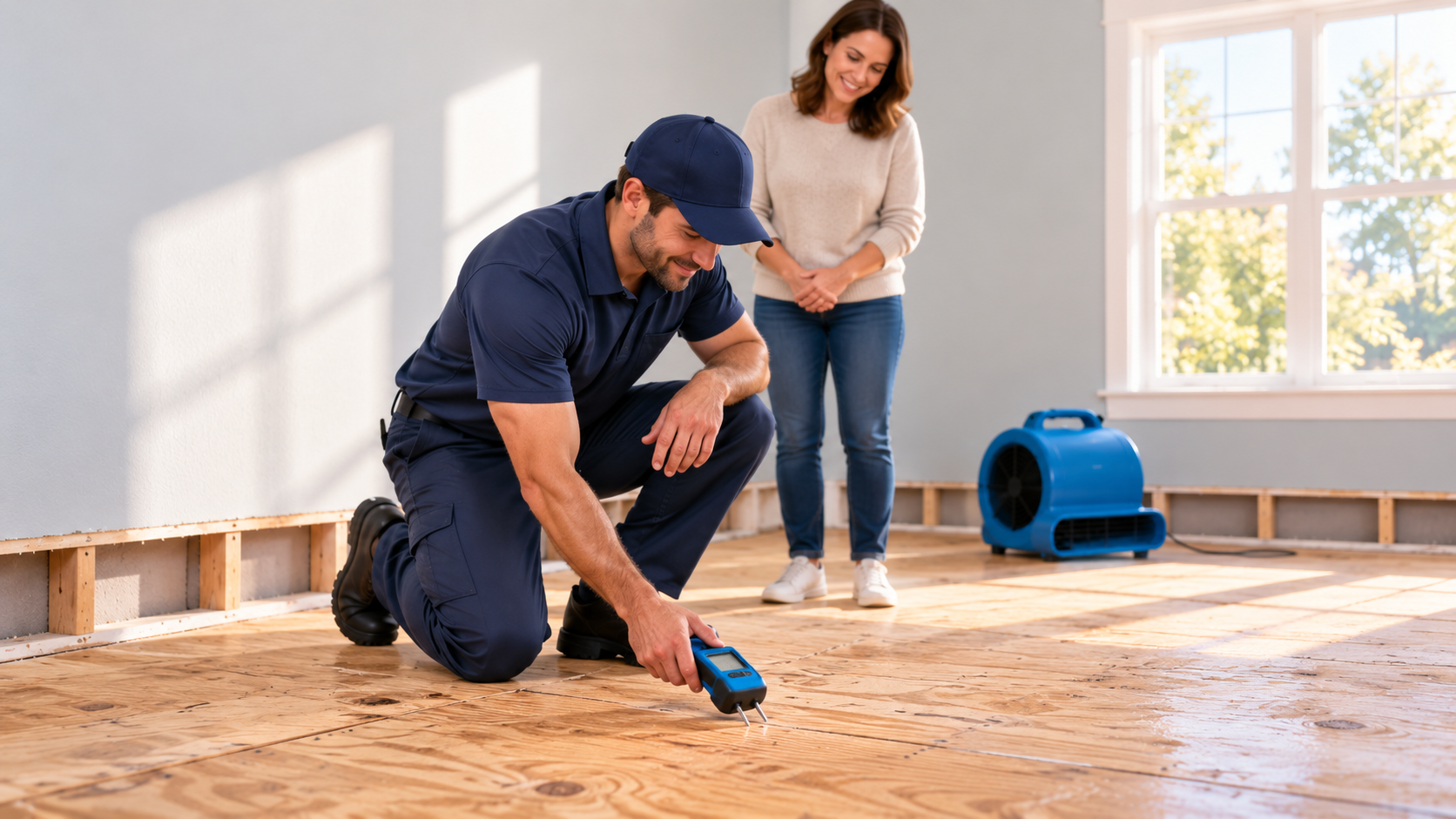
An inexpensive pin meter gets you surprisingly far. Take a reading on the same material somewhere it never got wet, in a closet or the next room, and treat that number as your goal. Pros call it the dry standard, and as a general benchmark, wood and drywall should read around 15 percent or below before you close anything up. Check the same spots daily. If the numbers stop falling for two days straight, something in your setup is wrong or there’s water you haven’t found.
Mistakes that turn three days into three weeks
- Shutting the equipment off at night. Drying is cumulative, and every idle hour lets moisture redistribute.
- Running the air conditioner instead of a dehumidifier. It pulls a little moisture, but it also cools the room, which slows evaporation.
- Drying only what you can see. If the floor was wet, the bottom of the wall probably is too.
- Painting, sealing, or laying flooring over damp material. Now the water is trapped and the problem is buried.
- Waiting a few days to see if it dries on its own. That pause is usually the most expensive decision of the event.
The same leak, two very different outcomes
Two neighbors had the same washing machine hose fail about a year apart. Ray was home when his went. He shut the valve, ran a wet vac over the laundry room and hallway carpet, tore out the pad that night, and had a borrowed dehumidifier and two fans going by morning. Five days later his readings matched the dry closet next door.
Down the street, the same hose let go on a Friday while the family was away. They got back Sunday, ran a box fan for a day, and put everything back. By spring the hallway had a soft spot and the bottom of two walls had to come out. Same failure, same water. The difference was the first two days.
When to stop and call a professional
Knowing how to dry out water damage yourself is genuinely useful for a small spill you caught early. There’s a line, though, and crossing it with rental fans usually costs more than the call would have.
Get a pro out if water reached inside walls, under flooring, or beneath a slab. If it came from a toilet, a sewer line, or outside flooding, it’s contaminated, and cleaning it safely matters more than drying it. Same story with water damaged hardwood, which needs specialty drying to have any chance. And if material has been wet longer than two days, or your readings won’t come down, bring in someone with real equipment. The EPA’s mold cleanup guidance also points homeowners toward professional help for large areas.
Does insurance pay for the drying?
Homeowners policies often cover water damage that’s sudden and accidental, and mitigation work like extraction and drying is commonly part of what gets paid. Every policy is different, so treat that as a starting point, not a guarantee. Trouble usually comes from slow, long term seepage that gets called a maintenance issue.
Photograph everything before you move it, keep receipts for rented equipment, and call your insurer early. Most policies expect you to act quickly to limit the damage, so waiting can hurt your claim as much as it hurts your house.
Key takeaways
- Remove as much water as you physically can before trying to evaporate any of it.
- Airflow, a dehumidifier, and warmth work as a set. Fans alone just relocate the moisture.
- Carpet pad, wet insulation, and baseboard usually have to come out first.
- Three to five days is common, but meter readings decide when you’re done.
- Contaminated water, hidden water, and anything wet more than two days belongs to a pro.
Questions homeowners ask
Can I dry out water damage with just fans?
For a small surface spill on tile or sealed concrete, often yes. For anything that soaked into drywall, carpet, or a subfloor, no. The moisture just leaves the material and settles back into whatever is coolest.
How to dry out water damage inside a wall?
You have to give the cavity a path for air. That means pulling the baseboard, drilling discreet weep holes low on the drywall, removing wet insulation, and aiming airflow along the wall while a dehumidifier runs. If the wall sat wet for days, replacement is usually the realistic answer.
How soon can I put the floor back down?
Only once the subfloor reads dry on a meter, not when it feels dry underfoot. Installing over damp material traps moisture between two layers, which is a common reason a repaired room develops a smell later.
What to do next
Knowing how to dry out water damage is worth it for the small stuff. Recognizing when you’re past that point is worth more.
WaterDamageOnCall is a water damage information and lead request service. We are not a licensed restoration contractor. This article is general information, not professional restoration, insurance, or health advice. A licensed local pro should assess your situation.
Call for fast 24/7 help, or request help through our form and we’ll connect you with a local water damage pro who can get equipment on site today.