
You bend down to unload the dishwasher and your sock comes away wet. Or you catch a thin dark line of water creeping out from under the kick plate while the cycle is still running.
The puddle you can see is usually the smallest part of the problem. A dishwasher sits in a boxed in space with a cabinet base beside it and a wall cavity behind it, so water travels sideways and down long before it shows up somewhere you can mop it.
So the first job isn’t cleaning. It’s stopping the water, cutting the power, then finding out how far it already went. A dishwasher leak caught in the first hour is usually towels and a fan. One that sat through a long weekend is cabinets, subfloor, and a call to a restoration crew.
Stop the cycle, then cut the power and the water
Cancel the cycle first. Most machines have a cancel or drain button that stops the fill and pumps out what’s in the tub. Try not to yank the door open mid cycle, because a full tub will dump onto the floor you’re trying to save.
Then cut power at the breaker labeled kitchen or dishwasher. Never reach into standing water for a cord or an outlet.
Now the supply. Under your kitchen sink, find the small valve feeding the line that runs toward the dishwasher and turn it clockwise until it stops. If it’s frozen from years of never being touched, close the main shutoff for the house instead.
One more thing, and people skip it constantly: don’t run the machine again to test it. A second cycle pushes fresh water right back through whatever just failed.
Get the water off the floor fast
Every minute that water sits, it’s soaking into something you can’t see. Old towels first, then a wet dry shop vacuum if you own one.
While you’re down there, open the door and look at the bottom of the tub. Standing water in the tub points at a drain problem. An empty tub with a wet floor points at a supply line or a seal. That one look narrows the cause more than an hour of guessing.
Move anything porous out of the way. Dishwasher water is usually clean or lightly contaminated, at the gentler end of the water damage categories, though that changes once it has sat for days.
Where a dishwasher leak actually comes from
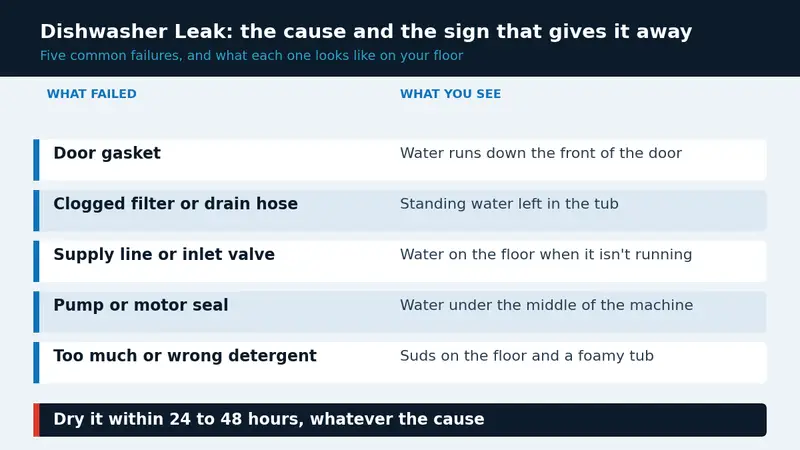
Five failures cause most of them, and each leaves its own clue.
The door gasket
The rubber seal goes hard, tears, or traps a chunk of food, and water escapes at the front and runs down the door face. Run a finger around it: stiff, cracked, or gapped means you found it, and it’s a cheap part.
A clogged filter or drain hose
Food plugs the filter basket or the drain hose, water backs up, and it overflows under the door. The tell is standing water left at the end of a cycle. Most machines want that filter rinsed monthly.
The supply line or inlet valve
The braided line corrodes at its fitting, or the inlet valve sticks partly open. This one is sneaky, because it leaks when the dishwasher isn’t even running. Water on the floor hours after the last cycle points at the supply side.
The pump or motor seal
The seal around the circulating pump wears out with age. Water shows up under the center of the machine rather than at the door, and it worsens over weeks.
Too much detergent, or the wrong kind
Regular dish soap creates a mountain of suds that push past the door seal. Sudsy water and a foamy tub means you found a habit, not a broken part.
Why the first 24 to 48 hours decide how bad this gets
Mold needs moisture, warmth, and something to feed on, and a wet cabinet base offers all three. In typical indoor conditions mold can begin growing within 24 to 48 hours of materials getting wet, which is why the EPA advises drying wet materials quickly. Our mold growth timeline walks through it hour by hour.
That number isn’t there to scare you. It’s a deadline.
Materials are on a clock too. The particleboard used for most cabinet bottoms swells and loses its grip on screws once soaked, and unlike solid wood, particleboard doesn’t really recover.
Here’s the part that surprises people. A slow drip is often worse than a dramatic flood. A flood gets noticed and dried. A pinhole weeps quietly behind the machine for weeks and rots the cabinet floor before anyone thinks to look.
Where the water hides in a kitchen
Once the floor looks dry, the real inspection starts. Water from under a dishwasher goes five places.
- Under the dishwasher itself, where there’s no airflow and nothing dries until the machine comes out.
- Under the flooring. Vinyl, tile, and laminate all shed water on top and trap it underneath. If you have wood, our guide to water damaged hardwood floors covers what can be saved.
- Into neighboring cabinets, since the toe kick space runs continuously along a whole bank.
- Into the wall behind, tracking along the supply and drain lines to the bottom plate.
- Down to the level below, showing up as a ceiling stain a day or two later.
How to dry it out, and how to know it’s actually dry
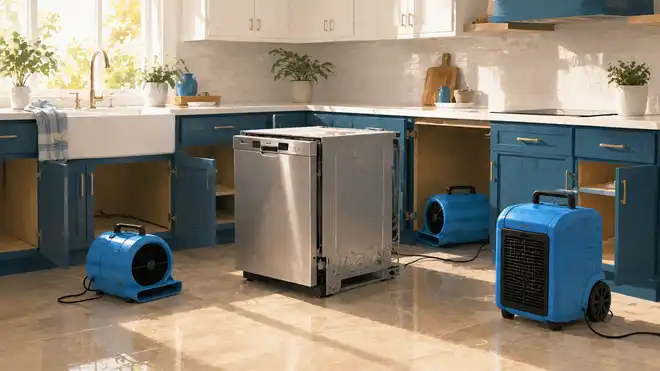
Empty the base cabinets, prop the doors open, and put a box fan or two blowing into the cabinet openings. Run a dehumidifier with the windows shut.
Pull the dishwasher out if the leak was anything more than a splash. Power off, water off, disconnect, then slide it forward onto cardboard. You can’t dry a space you can’t reach.
A simple floor spill caught fast often needs a day or two of air movement. Water that got into cabinets or under flooring generally takes three to five days with proper equipment.
When do you stop? Professionals take a reading from a dry area of the same material, then dry the wet area until it matches. Meter readings decide that, not the calendar, and definitely not whether the surface feels dry to your hand.

When to call a professional
Plenty of kitchen leaks really are a towel and a fan. Some aren’t. Call a restoration company if any of this is true:
- Water spread past the kitchen into another room
- Cabinets, the subfloor, or the base of the wall got soaked, not just splashed
- There’s a fresh stain on the ceiling below
- The leak had been going for days or weeks before you found it
- The floor still smells musty after a couple of days of fans
- Flooring is buckling or lifting at the seams
A crew brings extraction gear, air movers, and dehumidifiers, plus moisture meters and infrared cameras that find water inside a wall without opening it. That last part is what you’re really paying for. Here’s how professional water extraction and drying works.
Does homeowners insurance cover a dishwasher leak?
It often does, with one important distinction. Policies commonly cover water damage that’s sudden and accidental, which is what a burst supply line or a failed pump seal looks like. Damage from a leak that dripped slowly for months is commonly excluded as a maintenance problem.
A policy may also pay to repair the damage while not paying to replace the appliance that caused it. Coverage varies by policy, insurer, and state, so none of this is a guarantee. Photograph everything before you clean, keep the failed part, and call your insurer early.
Common mistakes that make it worse
- Running one more cycle to see if it still leaks. It will.
- Mopping the visible water and calling it handled while the cabinet base quietly rots.
- Leaving the machine in place. The wettest area is the part nobody uncovered.
- Closing cabinet doors during drying, which turns each cabinet into a small humid box.
- Waiting to see if the musty smell goes away. A musty odor means active moisture.
- Throwing out the broken part before the insurance conversation.
Two kitchens, two very different weeks
Priya heard a gurgle during an ordinary Tuesday load and found half an inch of water spreading across her tile. She hit cancel, flipped the breaker, closed the valve under the sink, and had towels down inside ten minutes. That evening she pulled the machine out, found a split drain hose, and ran fans into the open cabinet for three days. Total damage: one hose.
A few streets over, a family left for a week with a supply line weeping a few drops an hour behind their dishwasher. Nobody saw it, because nobody looks behind a dishwasher. They came home to a swollen cabinet base, a soft spot in the vinyl plank, and a smell they couldn’t place. That one became extraction, cabinet removal, subfloor drying, and a mold assessment.
Same appliance, same failure. Only the waiting differed.
Key takeaways
- Cancel the cycle, cut power at the breaker, then close the supply valve.
- Water in the tub means a drain problem. A dry tub with a wet floor means a supply or seal problem.
- Mold can start within 24 to 48 hours, so drying speed matters most.
- Pull the dishwasher out. The wettest area is the part you can’t see.
- Insurance often covers sudden failures and commonly excludes slow leaks.
- Dry until a moisture meter agrees, not until the surface feels dry.
Frequently asked questions
Can I still use my dishwasher if it only leaks a little?
Better not to. A small leak under pressure still puts water into the cabinet base every cycle. Leave it off until the cause is fixed.
How long does it take to dry a kitchen after a dishwasher leak?
A surface spill caught fast is often dry in a day or two with fans. Water that reached cabinets, flooring, or a wall generally takes three to five days with professional equipment.
Is a leaking dishwasher worth repairing?
Often yes, especially for a gasket, filter, hose, or supply line. A failed pump seal or a cracked tub on an older machine is where many homeowners decide replacement makes more sense.
WaterDamageOnCall is a water damage information and lead request service. We’re not a licensed restoration contractor, and this article is general information rather than professional restoration, insurance, or health advice. A licensed local pro should assess your specific situation.
If water from a dishwasher leak reached your cabinets, your flooring, or your walls, don’t wait to find out how far it went. Call for fast 24/7 help, or request help through our form and we’ll connect you with a local pro who can measure what’s wet and start drying today.